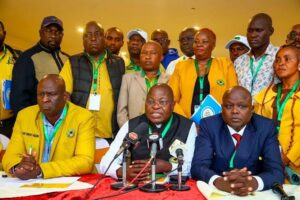
Junior school teachers say KUPPET has failed them and are now preparing to form or join alternative unions. This article explores why educators are ready to walk away and what this means for the future of teacher representation in Kenya.
Kenya’s education sector is on the brink of a major transformation as thousands of junior school teachers prepare to cut ties with the Kenya Union of Post-Primary Education Teachers (KUPPET). The move comes after months of rising frustration, and according to the Kenya Junior School Teachers Association (KEJUSTA), it is not just a protest—it is the beginning of a new era of self-representation.
As Chipuko Digital Reports, Junior school teachers, who form one of the largest blocs within KUPPET with more than 46,000 members, say the union has repeatedly failed to recognise their importance despite benefitting immensely from their membership dues. For years, they believed KUPPET would be the platform that champions their professional identity, supports their legal battles and fights for their welfare. Instead, they say they found indifference.
KEJUSTA Chairperson James Odhiambo confirms that teachers have already begun the official process of withdrawing from KUPPET. The decision comes after what he describes as “consistent neglect” from a union whose leaders appear more focused on revenue than member welfare.
Odhiambo argues that junior school teachers have been treated as a financial machine within the union. With each contributing around Sh890 every month—totalling approximately Sh41 million—junior school educators play a significant role in keeping the union financially stable. Yet the representation they receive, Odhiambo says, does not reflect their contributions.
One of the biggest sources of discontent is KUPPET’s alleged reluctance to support the struggle for junior school autonomy. Teachers have insisted that junior school should be administered as a different entity from secondary school to eliminate confusion, streamline management and create room for specialised promotion structures. But despite early promises, KUPPET has allegedly stepped back from championing the cause.
KEJUSTA’s pursuit of autonomy led them to prepare a legal petition for the High Court. When they approached KUPPET for financial and institutional support, the union declined—a decision that many junior school teachers interpreted as a glaring betrayal. They also accuse the union of delaying a petition meant to reach the National Assembly, arguing that KUPPET has shifted positions and aligned itself with the very systems teachers hoped to challenge.
These frustrations have triggered a sweeping demand: junior school teachers want their own union.
Odhiambo says teachers are now convinced that their future lies outside KUPPET. They want a union where their voices are not diluted, their concerns not sidelined, and their professional needs not treated as secondary issues. They seek leadership that understands their unique classroom challenges, career stagnation concerns and structural frustrations brought by the Competency-Based Curriculum (CBC).
For many teachers, breaking away is not a sudden move—it is the result of years of feeling invisible. KEJUSTA members say their priorities have never been reflected in KUPPET’s agenda. Even positions offered to junior school teachers in the upcoming elections feel like an afterthought rather than meaningful integration.
KUPPET, however, insists it has not mistreated junior school teachers. A senior official states that unions are built on voluntary membership and that KUPPET cannot force anyone to stay. He maintains that the union has held regular engagements with the Teachers Service Commission (TSC) and the government to discuss issues affecting junior school, including confirmation of interns and improving the promotion matrix.
But KEJUSTA members argue that KUPPET’s engagements have lacked urgency and intensity. They feel that major issues affecting junior school teachers only receive attention when teachers threaten withdrawal or public pressure mounts.
The sentiment among many educators is that KUPPET has grown too comfortable, too bureaucratic, and too slow to react to the rapidly evolving needs within Kenya’s new curriculum framework. Junior school is still a new system, requiring bold advocacy—but teachers say KUPPET has chosen caution over courage.
The push to form a new union or join alternative representation bodies reflects a larger national trend. Teachers across Kenya are gravitating towards unions that speak directly to their needs rather than relying on traditional structures that may no longer serve them effectively.
Whether this movement will result in an entirely new union or a mass migration to another existing one remains to be seen. But what is certain is that junior school teachers have reached a tipping point. The era of silent frustration is over, and the call for dedicated representation is louder than ever.
The message is unmistakable: If KUPPET cannot fight for junior school teachers, then junior school teachers will fight for themselves.