Kenya’s junior school teachers are preparing to abandon KUPPET, accusing the union of negligence, weak advocacy, and prioritising dues over members’ welfare. Here is the full story behind the looming fallout.
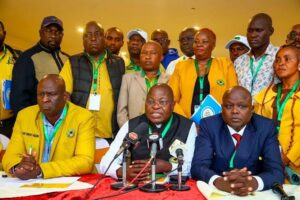
A major storm is brewing within Kenya’s education sector as thousands of junior school teachers signal an unprecedented withdrawal from the Kenya Union of Post-Primary Education Teachers (KUPPET) according to Chipuko Digital . For months, tensions have simmered beneath the surface, but the decision by the Kenya Junior School Teachers Association (KEJUSTA) to spearhead a coordinated mass exit marks a turning point that could reshape the country’s union landscape.
The group, which brings together more than 46,000 junior school educators recently absorbed into government employment after two years as interns, accuses KUPPET of abandoning their core concerns and reducing their membership to a mere source of monthly deductions. Each teacher contributes approximately Sh890 — a sum that collectively channels about Sh41 million into KUPPET’s accounts every month. According to KEJUSTA leaders, this financial strength has not translated into meaningful representation.
KEJUSTA Chairperson James Odhiambo argues that KUPPET’s leadership has repeatedly failed to champion the priority issues affecting junior school teachers, particularly the long-standing push for professional and administrative autonomy. Many educators believe junior school should operate independently rather than be lumped under secondary school structures — a change they say is crucial for improving management and career progression.
Mr. Odhiambo notes that despite junior school teachers forming a significant bloc within the union, they have only been allocated a minimal number of leadership slots in upcoming elections. This, he says, proves their views are undervalued.
The frustrations run deeper. According to Odhiambo, the group initially approached KUPPET to help fund a High Court legal battle seeking autonomy for junior school. Their request was allegedly dismissed, forcing KEJUSTA to push forward alone. When they later forwarded a petition meant to be presented to Parliament, he claims KUPPET stalled the process, citing the need to “consult with the Teachers Service Commission (TSC)” first — a move junior school teachers interpreted as reluctance or betrayal.
Odhiambo insists the union’s shifting stance on junior school matters has left teachers disillusioned. What began as a collaborative effort, he says, has morphed into a situation where KUPPET appears more aligned with institutional interests than with the educators who fund the organisation.
“It is now clear that we must take charge of our own destiny,” Odhiambo asserts. “We cannot remain under a leadership that sidelines our needs while enjoying the contributions we make every month. Our teachers deserve a union that sees them, hears them, and actively represents them.”
Despite the mounting accusations, a senior KUPPET official — speaking anonymously — maintains that the union has been consistent in its engagement with stakeholders and is committed to resolving junior school challenges through dialogue rather than confrontation. He argues that joining or leaving a union is voluntary, emphasising that KUPPET cannot coerce anyone to stay.
The official also revealed that junior school teachers have been offered representation within the union, including a designated position in the upcoming elections. According to him, KUPPET prefers structured engagement and views legal or industrial action as last-resort measures.
However, KEJUSTA leaders feel these gestures came too late and do little to address deeper issues. They insist that junior school teachers have waited long enough and that the lack of tangible progress on autonomy, career pathways, workload issues, and recognition has left them with no alternative.
In the midst of the dispute, KUPPET National Chairman Omboko Milemba recently stated that the union has scheduled a meeting with TSC to prioritise issues such as confirming the 20,000 junior school interns into permanent and pensionable terms and reviewing promotion guidelines. He added that according to TSC regulations, the commission has no mandate to employ teachers as interns — a sentiment that echoes KEJUSTA’s position.
As tensions escalate, one thing is clear: Kenya’s education unions are headed for a decisive moment. Should the mass withdrawal occur, it would be one of the largest in the country’s history, potentially weakening KUPPET’s influence while empowering emerging teacher movements.
For now, all eyes remain on the junior school teachers a group determined to chart a new path after years of feeling unheard.