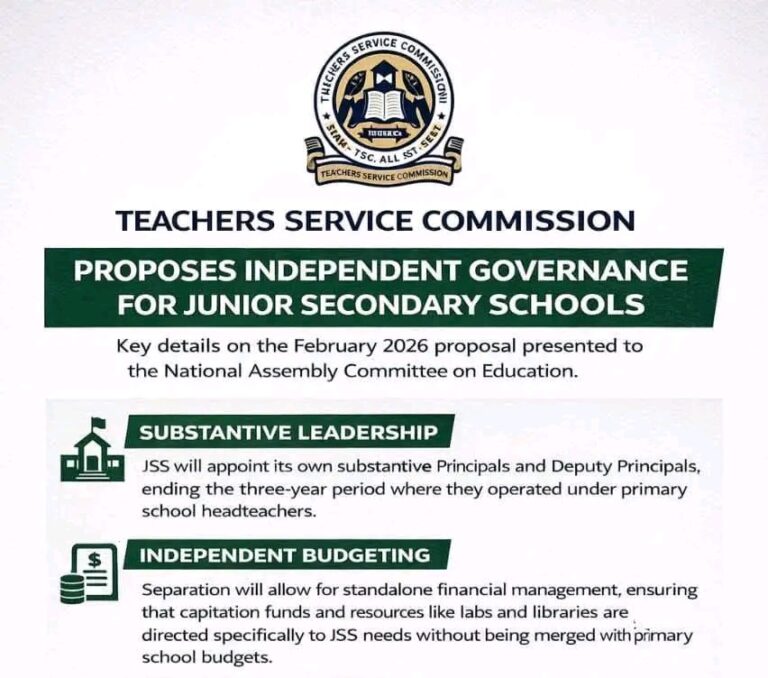
The landscape of Kenyan education is bracing for a seismic shift. In a landmark presentation to the National Assembly Committee on Education this February 2026, the Teachers Service Commission (TSC) formally proposed a transition toward independent governance for Junior Secondary Schools (JSS).
Since the inception of the Competency-Based Curriculum (CBC), JSS has largely existed as an extension of primary schools, often managed by primary headteachers. This new proposal aims to tear down those administrative walls, granting JSS the institutional identity and leadership it needs to thrive as a distinct tier of education.
The “interim” period of JSS being managed by primary school administration is coming to a close. The TSC’s proposal outlines a strategic roadmap focused on four critical pillars:
1. Substantive Leadership and Career Growth
For the first time, JSS will appoint its own substantive Principals and Deputy Principals. This isn’t just a change in title; it’s a massive win for career progression within the teaching service. By creating dedicated administrative tracks for JSS, the commission is opening up thousands of leadership opportunities for qualified educators.
2. Financial Independence through Standalone Budgeting
One of the biggest pain points for JSS has been the “merging” of funds with primary schools. The new proposal advocates for independent budgeting. This ensures that capitation funds and essential resources—specifically for science labs, computer rooms, and libraries—are ring-fenced for JSS students rather than being absorbed into general primary school overheads.
3. Raising the Bar for Staffing Qualifications
The TSC is taking a firm stance on academic excellence. Under the new structure, JSS administrators must hold minimum academic qualifications equivalent to secondary school levels, which typically means a university degree. This move ensures that the pedagogical leadership in JSS matches the complexity of the secondary-level curriculum.
The Road Ahead: Legal and Financial Hurdles
While the proposal has been met with excitement by many educators, it isn’t without its challenges. Implementation will require:
Legislative Amendments: Both the TSC Act and the Basic Education Act must be amended to formally recognize JSS as a separate legal entity with its own administrators.
Increased Funding: The TSC has been transparent about the fact that “autonomy isn’t free.” The government will need to allocate additional funding to cover the salaries and benefits of this new cadre of administrative leaders.
A New Chapter for Kenyan Students
By granting JSS its own “voice” and its own budget, the TSC is signaling that the middle-school tier is no longer an afterthought. For students, this means better-equipped labs and more focused leadership. For teachers, it represents a clear, professional path forward.
As this proposal moves through the National Assembly, the education sector remains optimistic that this independence will be the catalyst for a more robust and specialized CBC delivery.