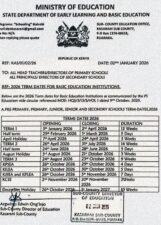
As the Teachers Service Commission (TSC) tightens its grip on school administration in 2026, a new legal reality is dawning for school principals across Kenya. The recent directive issued by Acting CEO Evaleen Mitei regarding the unconditional release of KCPE and KCSE certificates is not merely a request—it is a formal enforcement of the Code of Conduct and Ethics for Teachers.
For the first time, the Commission has explicitly linked the withholding of academic documents to “professional misconduct,” a charge that can lead to interdiction or permanent removal from the teaching register.
Many school heads argue that they are caught in a financial “pincer movement.” With the government’s capitation often delayed and parents owing millions in school fees, certificates have long been the only effective tool to ensure institutional solvency.
However, the TSC’s Article 2 of the 2026 reforms clarifies that institutional debt is a civil matter between the parent and the school board, whereas a certificate is a statutory right belonging to the learner. By using certificates as collateral, principals are effectively stepping outside the law, exposing themselves to personal liability.
The TSC’s legal team has pointed to the Basic Education Act of 2013, which prohibits any person from restricting a learner’s access to educational opportunities. Since a KCSE certificate is a mandatory requirement for university placement and most job applications, withholding it is legally interpreted as “denial of the right to education.”
Under the new 2026 enforcement framework, any head of institution who defies the circular will be deemed to have violated the KNEC Act 2012, which carries specific penalties for those who obstruct the distribution of national examination results.
To ensure this directive isn’t ignored like previous Ministry of Education circulars, the TSC has empowered Regional and County Directors to act as “compliance monitors.” These officers are now required to submit monthly reports on any school heads who refuse to comply.
If a parent reports a withheld certificate, the County Director has the authority to issue a Show Cause Letter to the principal immediately. This decentralization of disciplinary power is part of the Sh700 million “Zonal Office” initiative designed to bring TSC oversight to the school gate.
The TSC’s ultimate goal is to restore the image of the teaching profession, which has been tarnished by “pay-to-play” administrative practices. By decoupling financial disputes from academic credentials, the Commission is signaling a shift toward human-centric governance.
As the 2026 academic year progresses, the TSC expects all 30,000+ school heads to align their practices with these ethical standards, ensuring that no student’s professional journey is derailed by an administrative ransom.
TAGS
TSC professional ethics for teachers, school principals legal liability Kenya, Basic Education Act 2013 certificates, TSC disciplinary action for headteachers, Evaleen Mitei circular 2026, KNEC Act penalties.